

This Spring, Façades in Frankfurt a.M. Couldn’t Contain Artists Any Longer — or Did They Ever?
On Labour Day, May 1st, artist Larry Bonćhaka reactivated the 14-metre sculpture in front of the Eurotower at Willy-Brandt-Platz through an eight-hour performance, The Cleaning Company GmbH. This somehow prompted a moment of reflection on the presence of art in public space and on a series of encounters, friendships, places, and memories I have experienced since moving to Frankfurt am Main.
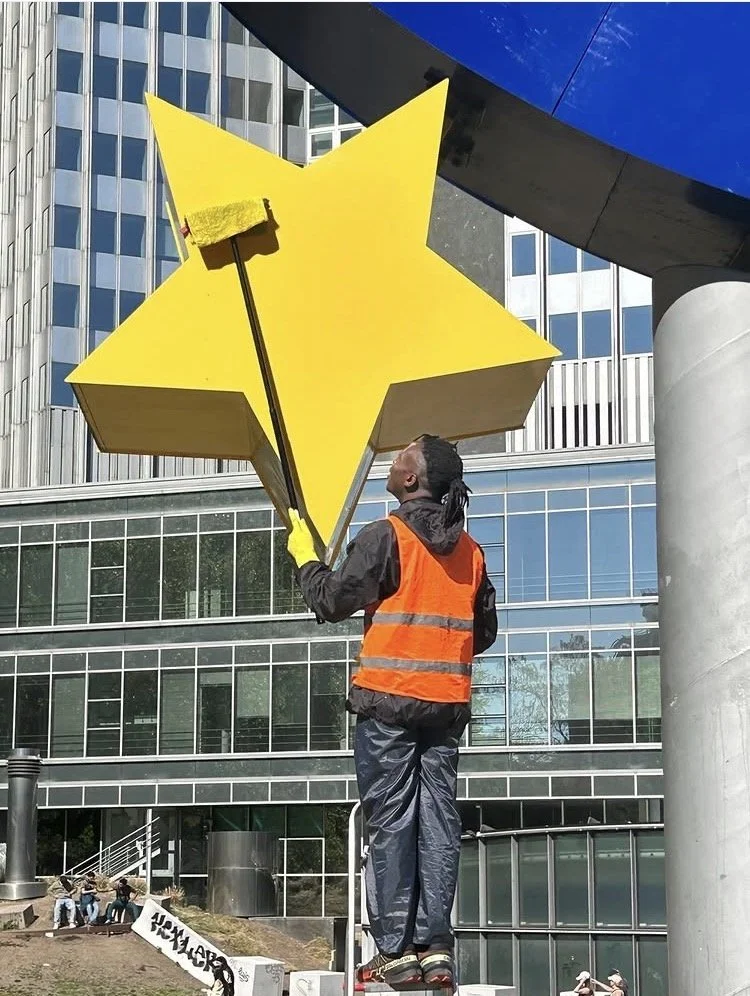
The cleaning company GmbH May 1st 2026, Willy Brandt Platz, Euro Monument - frankfurt am Main, photo courtesy Gintare Sokelyte.
When speaking about art in public space here, it is difficult not to think of the traces and connections fostered by curator Andrés Gorzycki through his Cards Project. For several years, Andrés facilitated artistic collaborations through public space initiatives and city-funded programmes, bringing together artists across local and international contexts. Although he later relocated the primary base of his practice from Frankfurt and Berlin to Posadas, Argentina, where he expanded his curatorial work through projects such as the Museo de la Triple Frontera, his influence continues to resonate within Frankfurt’s artistic landscape.
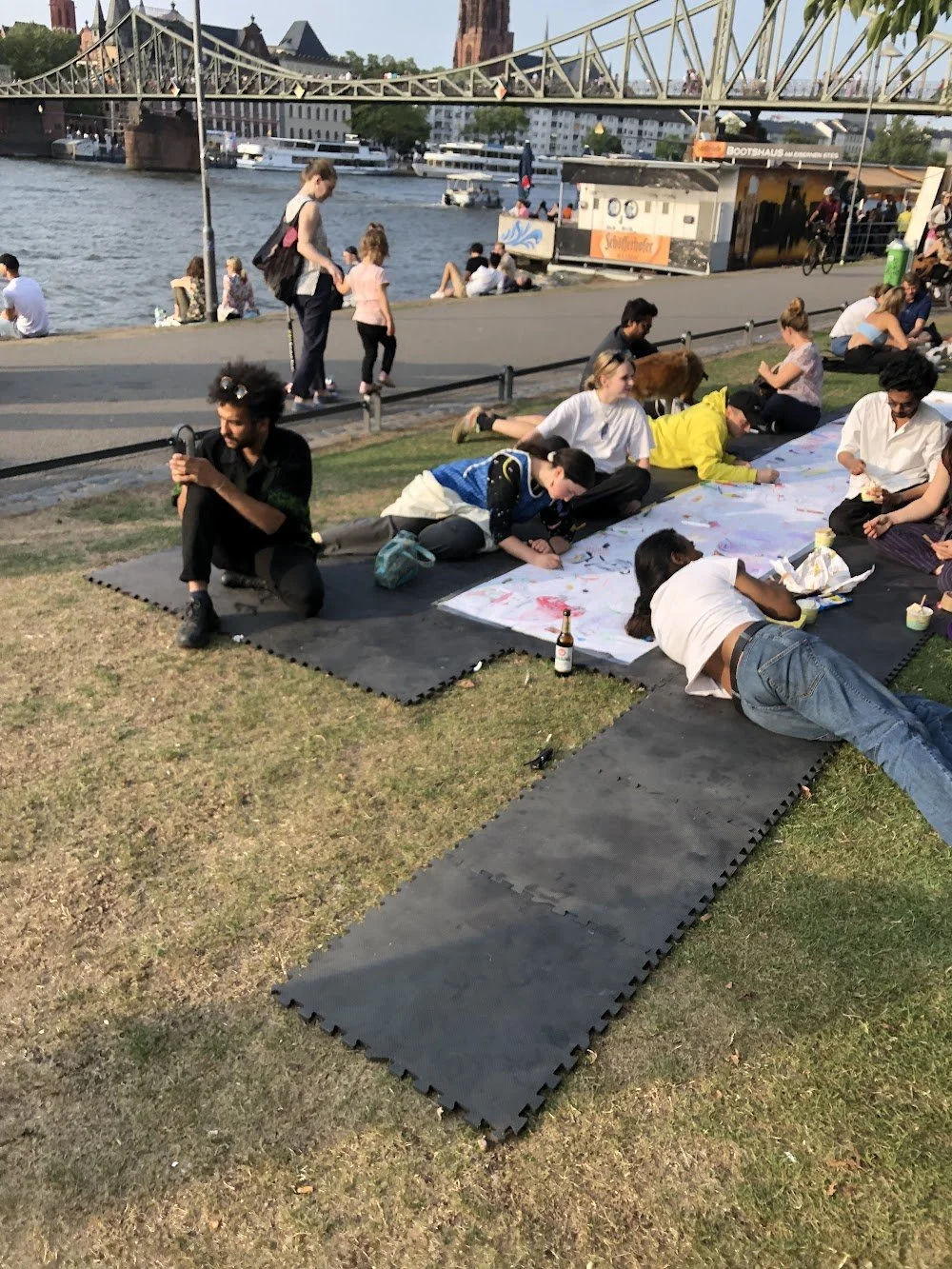
Commune 6x3 , Puzzle Mat, 2023. Courtesy of Andrés Gorzycki.
During his years along the Main river, Andrés collaborated with artists who remain active within the city's public art scene, including Yuxiu Xiong, Imaan Sattar, Tomás Maglione, Markéta Adamcová, Nina Nadig, commune6x3, and myself. Through these collaborations, he cultivated not only projects but also networks of exchange, friendship, and artistic experimentation. The traces of these encounters continue to unfold across different geographies, extending their presence wherever Andrés finds inspiration in another curious soul and a new context for connection.
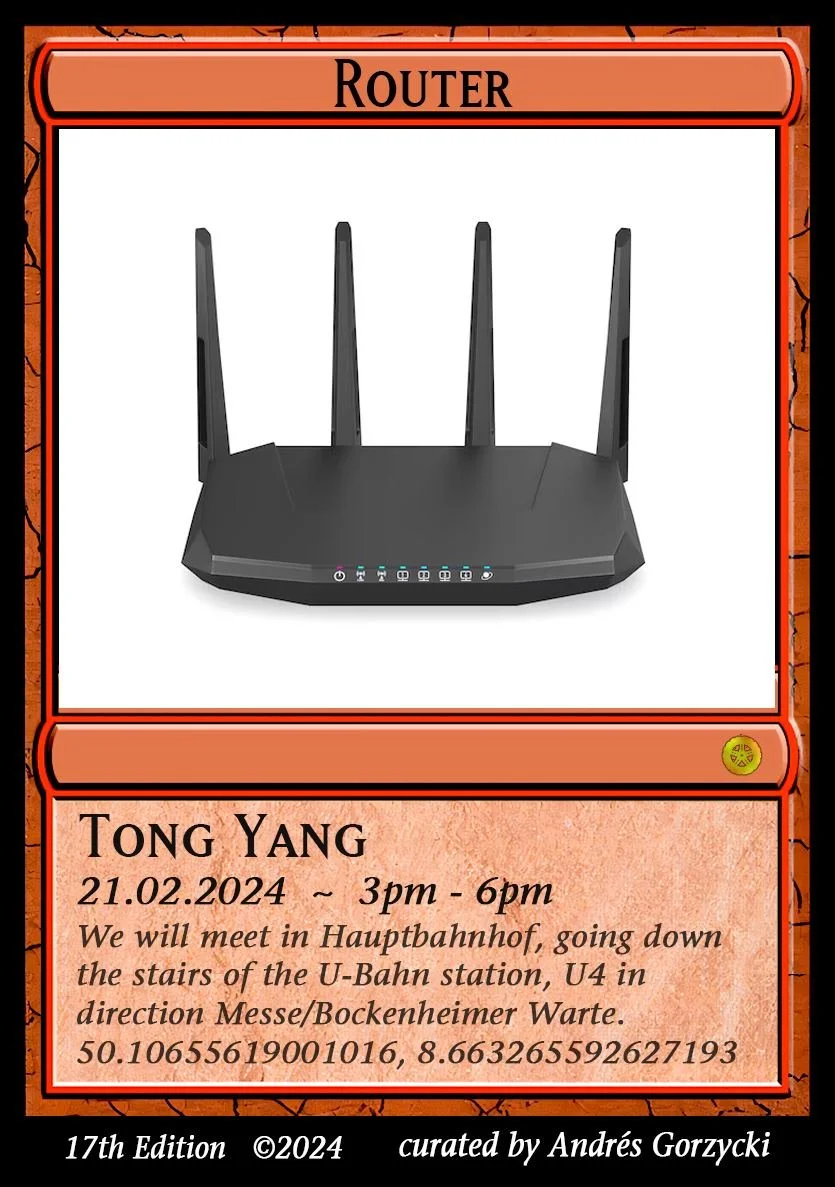
Card Router 2024, Courtesy of Andrés Gorzycki.
The card I developed in collaboration with Andrés was called Router, a collaboration created together with a group of artists in Shenzhen, including Xu Hongbin, Beina, Dayu, Huang Wenya, Huangyin, Hu Yifei, Moxun, Yi Xiaodong, Zhou Jinhua. The work employed a CCTV camera installed by artists temporarily for the performance in a small hotel room rented by the group in Dongguan for performances, a city shaped by the movements of migrant factory workers from across China. This hotel functions as a temporary space of leisure and intimacy, offering a brief respite from the repetitive rhythms of industrial labour. Through a live video stream, this highly private environment was projected onto an otherwise empty wall inside Frankfurt Hauptbahnhof, one of the city's busiest sites of circulation and transit. The projection was intentionally modest, using a small remote projector that could easily blend into its surroundings. In this displacement, an intimate interior from southern China became momentarily entangled with the flows of anonymous bodies moving through a major European transportation hub. The intervention remained visible until it was eventually discovered by station security. Rather than being removed entirely, we relocated the projector to a less conspicuous area behind a row of rubbish bins, where it continued to exist within public space while remaining accessible to those who happened upon it.
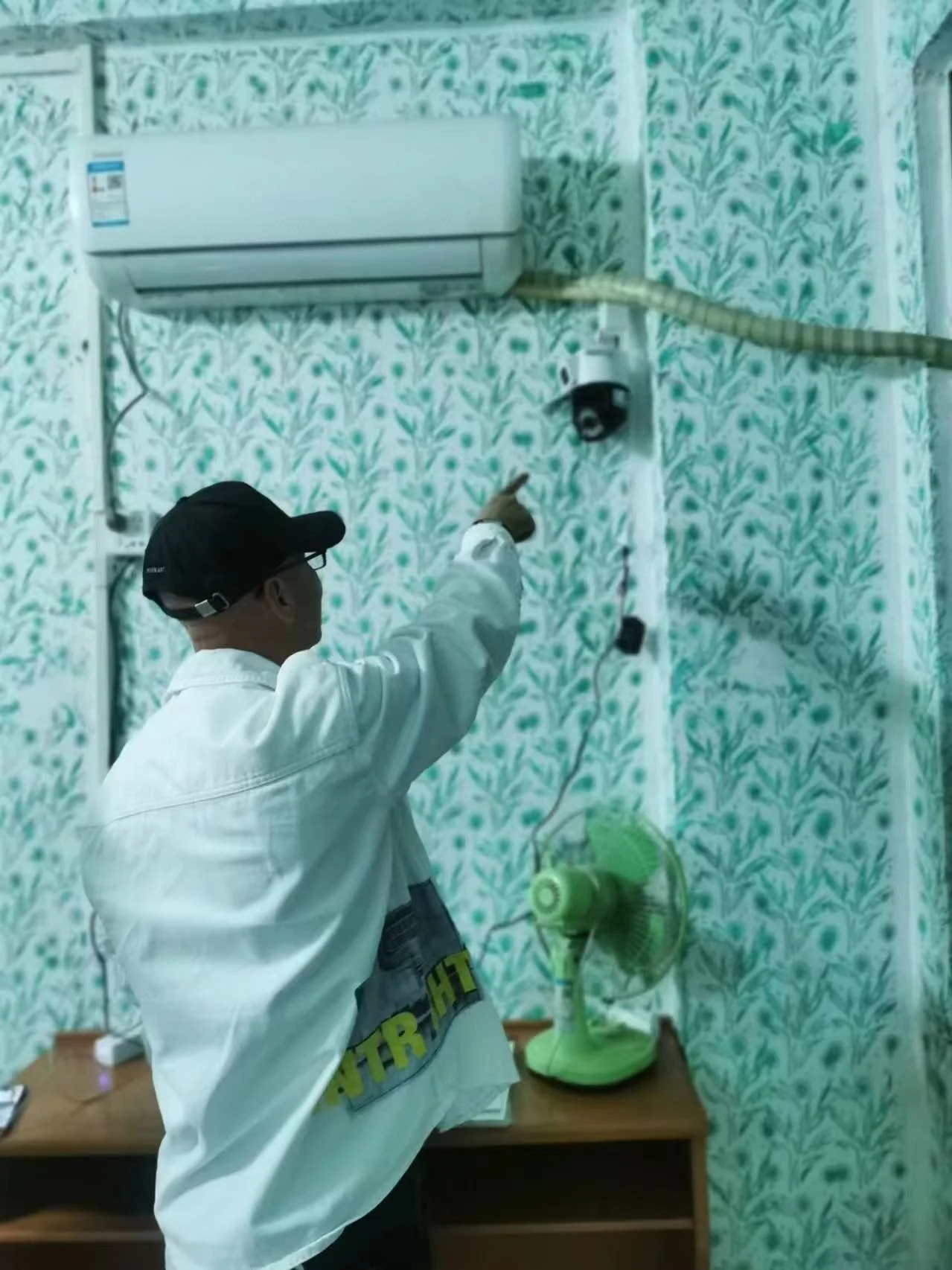
Artist interacting with the CCTV camera, 2024, A Glimpse into Heaven, On-site performance view, Dragon Phoenix Hotel, Heaven Village, Dong Guan, China, 2024. Courtesy of MetalinkArt
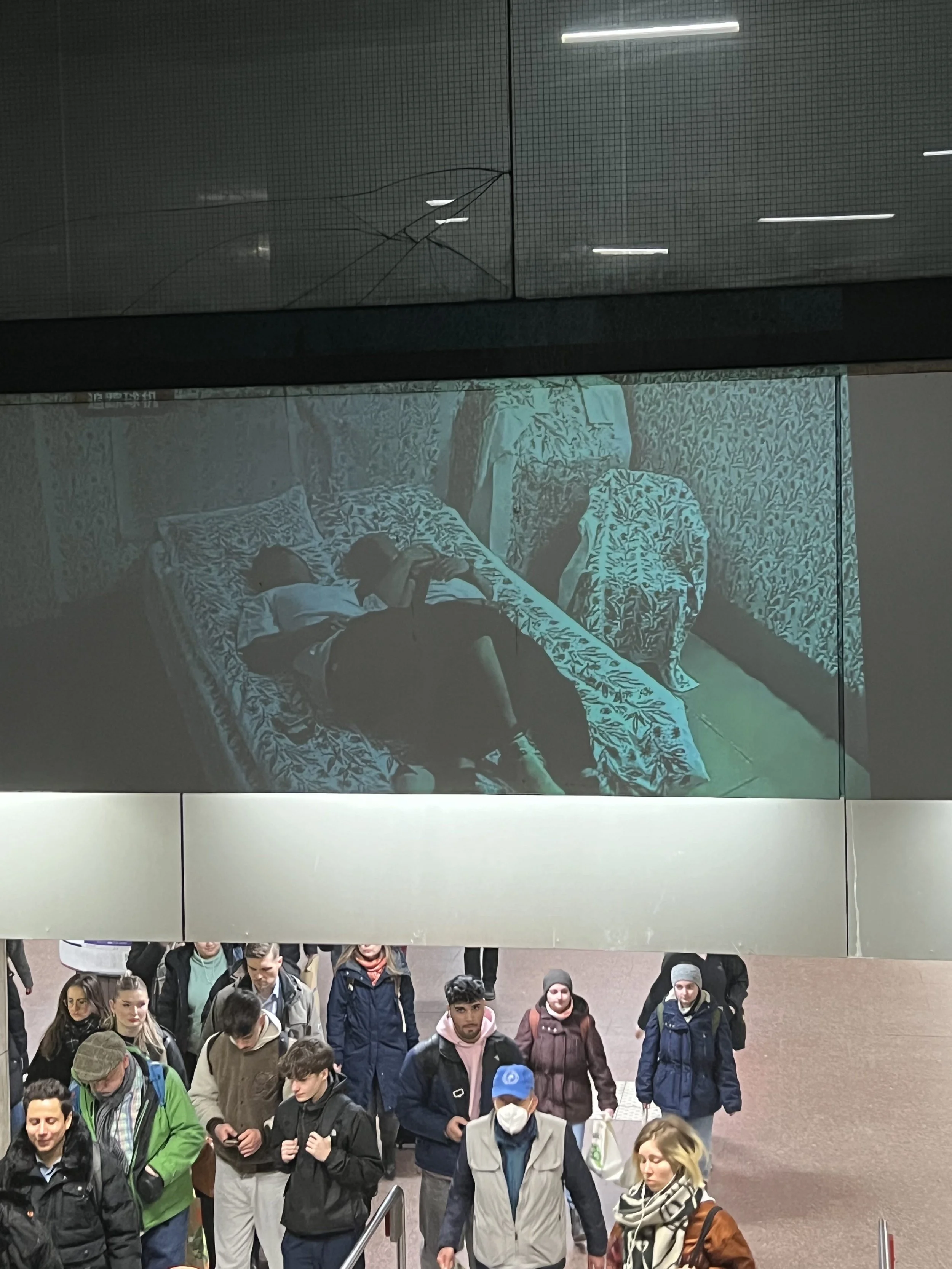
Live streaming projection in Hauptbahnhof Frankfurt a. M. Router 2024. Courtesy of Andrés Gorzycki.
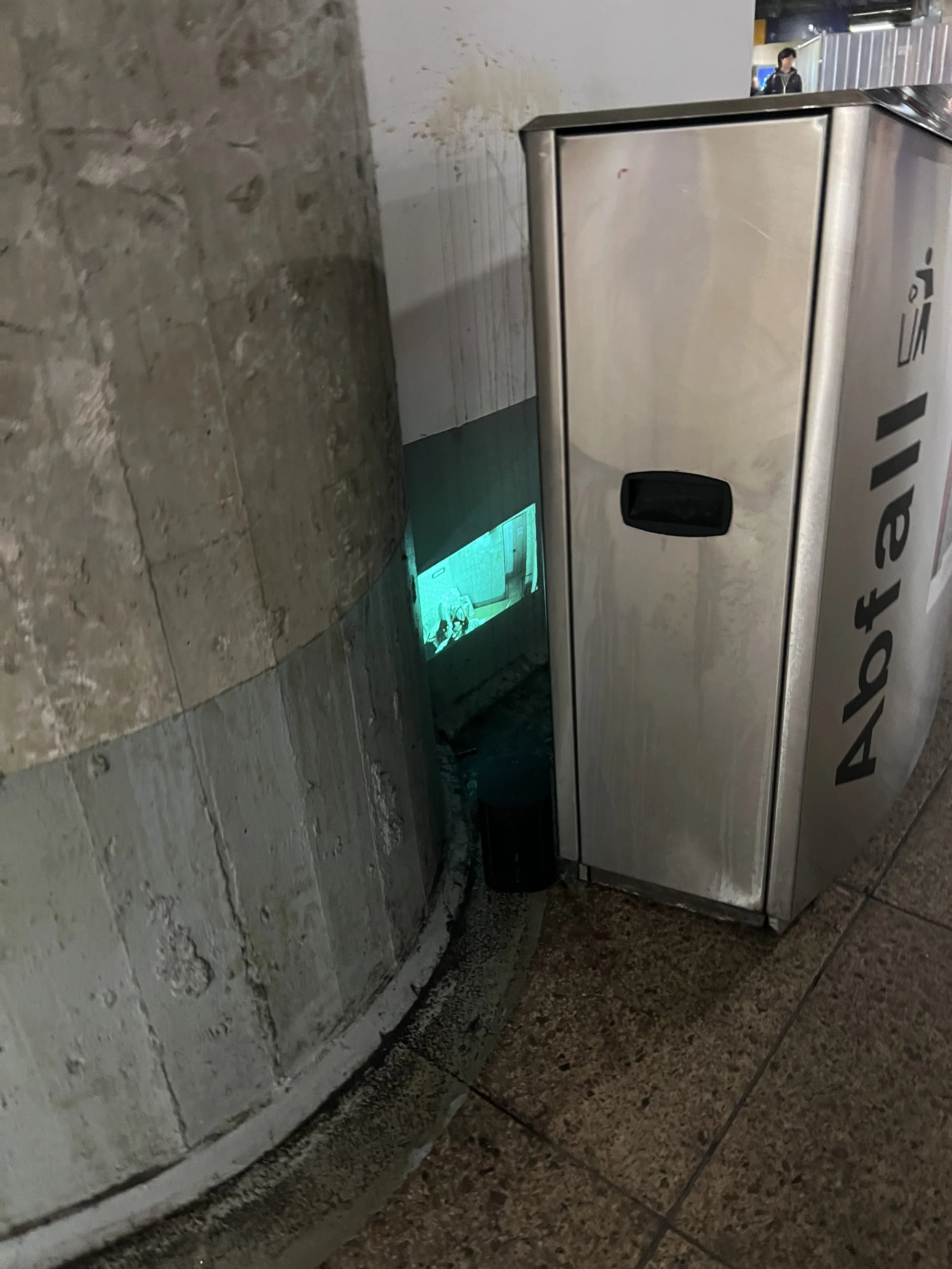
Projection was moved behind the bin Router 2024. Courtesy of Andrés Gorzycki.
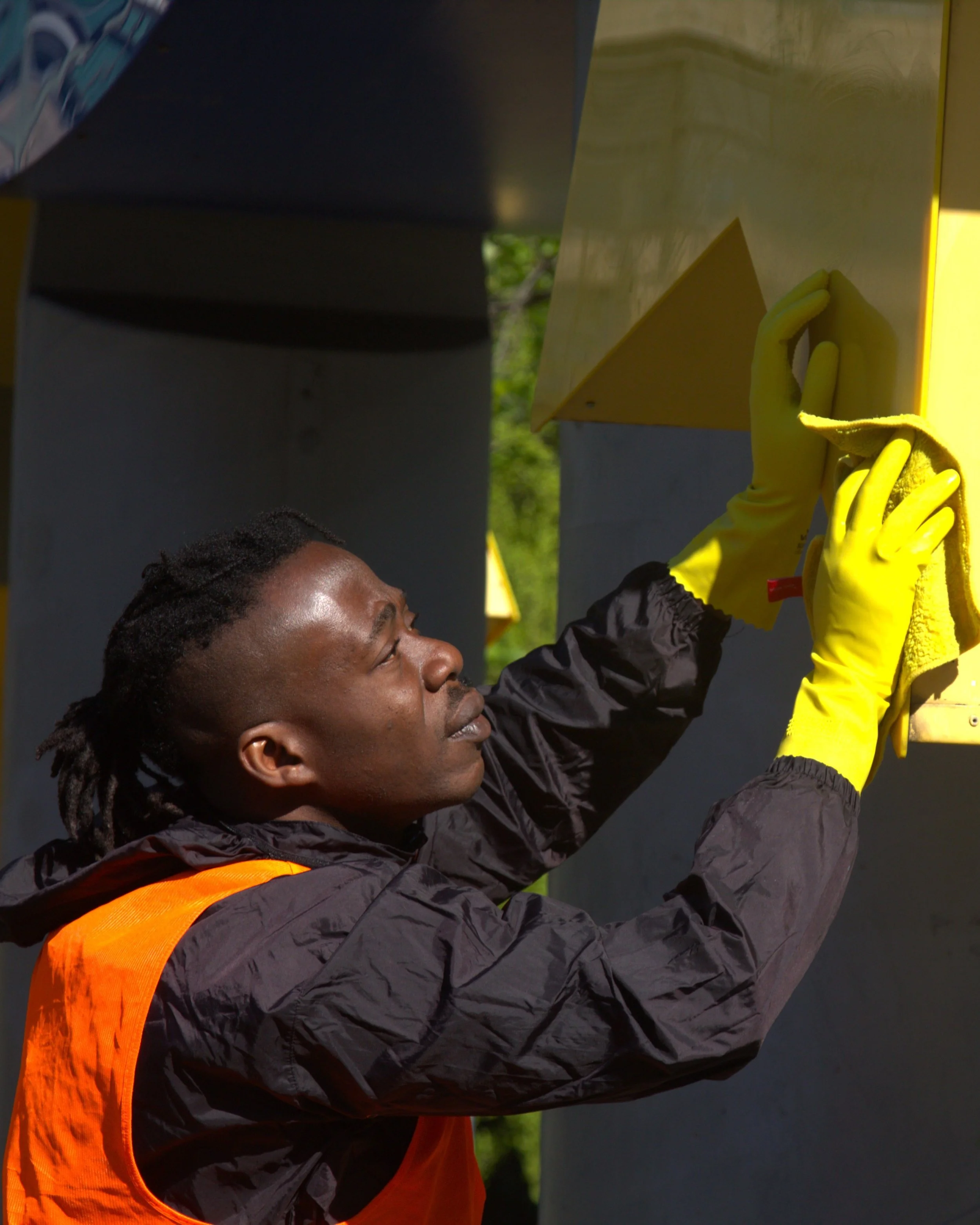
The cleaning company GmbH 2026, Willy Brandt Platz, Euro Monument - Frankfurt am Main, photo courtesy Sibo Sheyang.
A very different situation unfolded when Larry performed The Cleaning Company GmbH on 1st May 2026. Dressed in an orange cleaner's safety vest and yellow rubber gloves, he stood atop a ladder holding an extended cleaning mop, meticulously wiping the iconic Euro sculpture—a monument to the European currency, a public artwork by German artist Ottmar Hörl lighted up in the transition into 2002 and has been standing in Willy Brandt Platz ever since. In this guise, no one questioned the presence of Larry. No police officers approached him. No passersby stopped to ask about the meaning of the performance. Paradoxically, this absence of attention marked the work's success. The action was absorbed so seamlessly into the visual and social fabric of the city that an unusual act performed on Labour Day became almost invisible. Through this hyper-effective camouflage, the performance revealed how certain forms of labour are rendered unnoticed precisely because they are so deeply embedded within everyday life.
Yet throughout the eight-hour performance, Larry witnessed a continuous stream of tourists stopping to photograph themselves in front of the Euro sculpture, posing with it almost as though it were a secular monument or site of pilgrimage. While the symbol of capital attracted endless attention, the labour required to maintain its appearance remained largely unseen. Not all passersby were indifferent to Larry's presence cleaning the Euro sculpture on Labour Day. One person approached him—not to inquire about the performance, but to ask whether he could step aside for a moment so they could take an unobstructed photograph of the monument. In these brief encounters, the work revealed another layer of its irony: the labour itself remained secondary to the image of the symbol being maintained.
The performance was documented by artist Sheyang Sibo. Looking back, I am glad to have played a small role in connecting these two spirits at the end of last year. In December, shortly before Sheyang Sibo's performance 10 Years, we were urgently searching for a videographer. At the last minute, Larry appeared with his DV camera and took the main role in the camera crew for his experience in public interventions. Sibo cut off his locks—hair he had been growing, cultivating, and carrying with him for a decade without cutting since leaving his home to pursue a nomadic artistic life. The locks cut off, measuring approximately 20 metres in total, were subsequently reconnected by Sibo using the same locking technique. Transformed into a single continuous line, they formed a circle measuring 4.8 metres in diameter and approximately 15 metres in circumference.
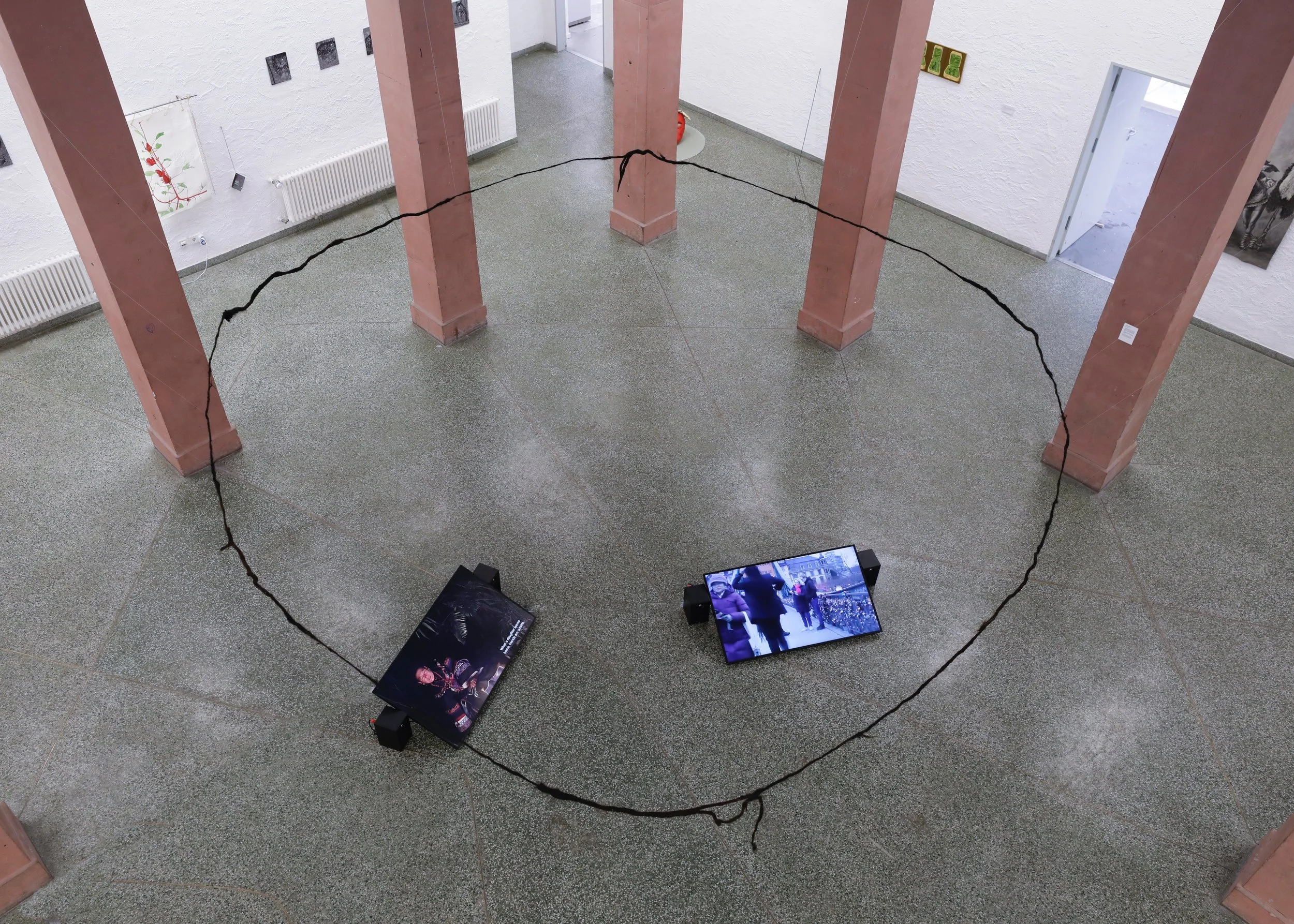
10 years 2015-2025, Installation view in Lichthalle during Rundgang of Städelschule 2026, courtesy of Sheyang Sibo.
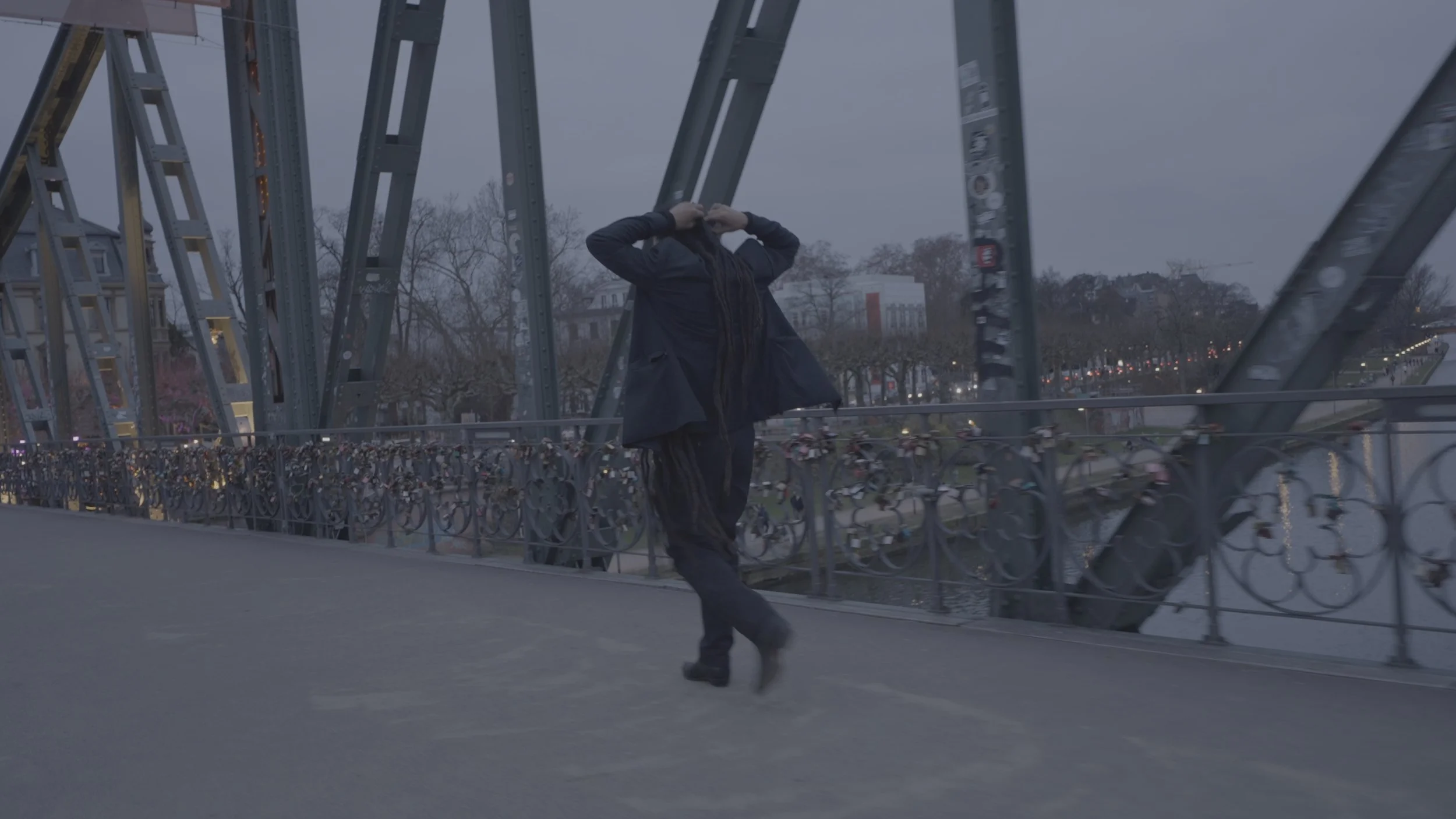
Sheyang Sibo cutting off locks passing Iron Bridge in Frankfurt a. M., photo by San Jang. Courtesy of artist.
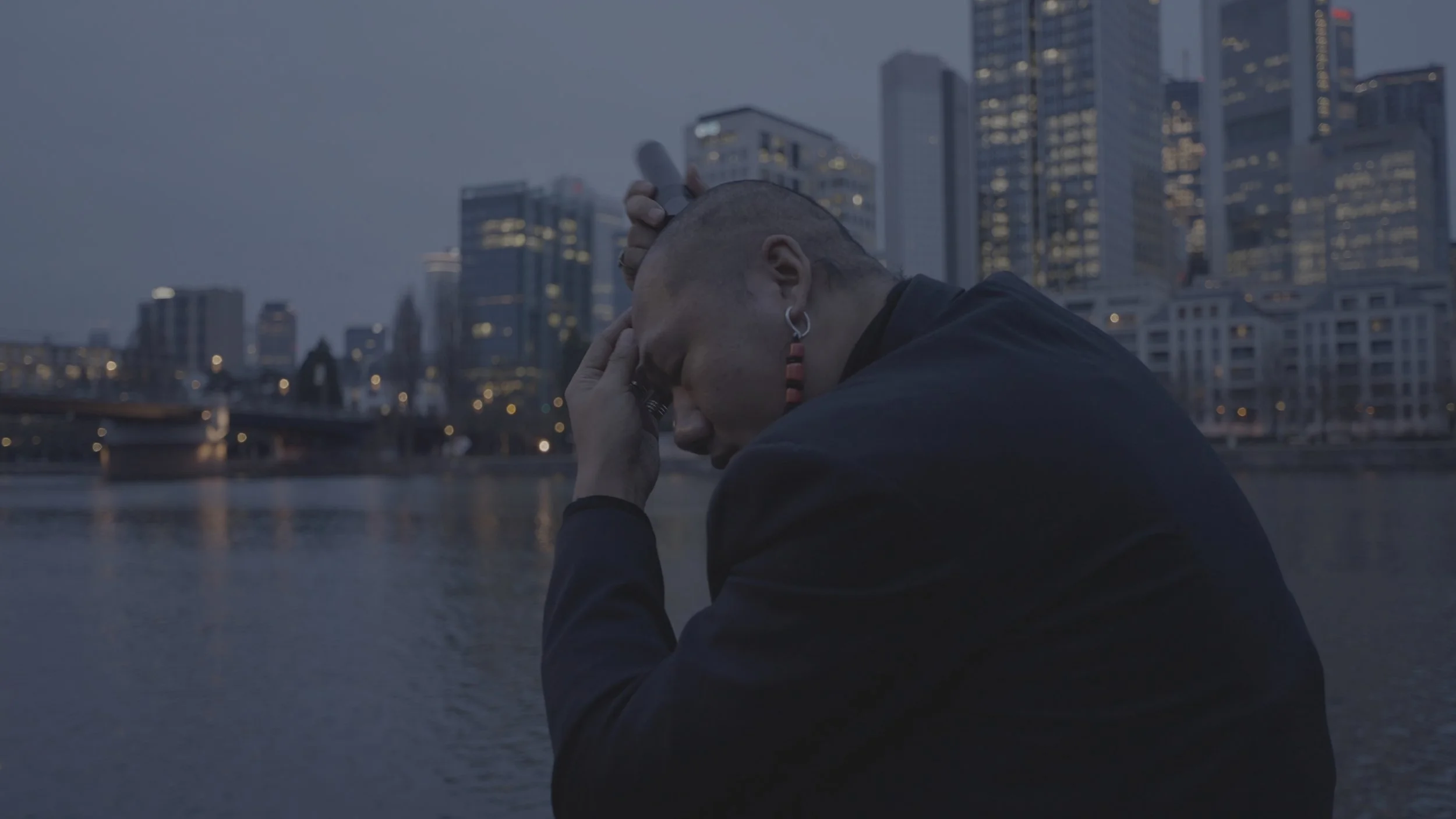
Sheyang Sibo shaving off the head along Main river, photo by San Jang. Courtesy of artist.
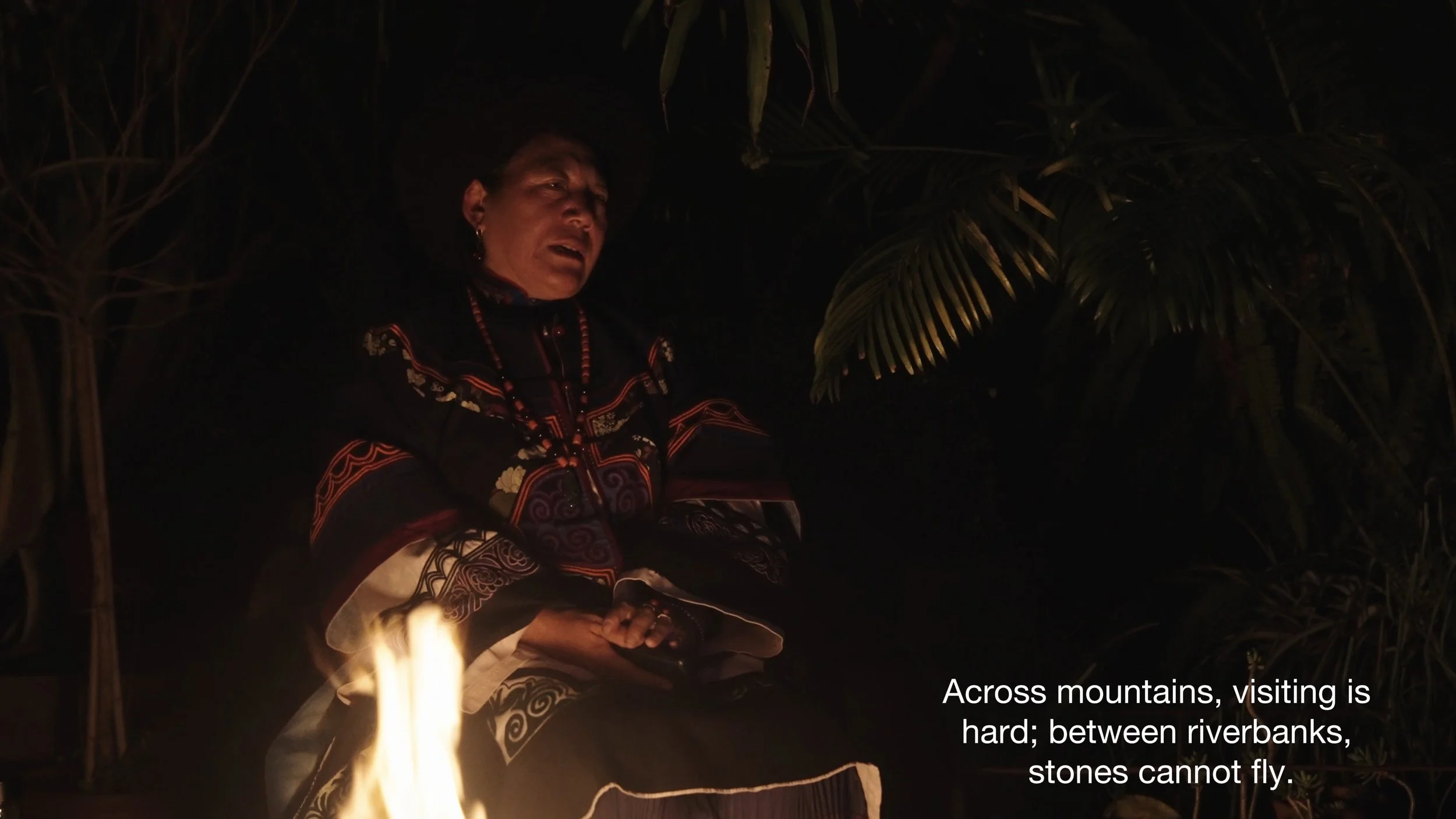
Sheyang Sibo’s mother singing. The melody derives from the traditional Yi tune “Niu Niu Huo” from southwest China, documentation by yihuoahuo, Courtesy of artist.
The work marked the tenth anniversary of an ongoing journey. At the time, this journey had brought Sibo to Frankfurt and the Städelschule. The performance began inside the Cathedral (Dom), from where he walked along the Main River, crossed the Iron Bridge (Eiserner Steg), and arrived at an open space in front of the Museum Angewandte Kunst. There, beside the river, he cut the final strand of his locks and completely shaved his head. The resulting video documentation, together with the unified circle of ten years' worth of hair and a film of his mother singing from his hometown in the Daliang Mountain, formed his Rundgang work this year in the Lichthalle at Dürerstraße 10. Installed at the centre of the exhibition space, these elements form the traces as both an archive and a monument of the artist’s lived experience, drawing a temporary yet significant period mark beneath a decade-long journey of movement, transformation, and becoming.
When vibrations persist at the same frequency, they begin to amplify one another. Since the beginning of this year, Larry has initiated a series of performances in public spaces across Frankfurt am Main, including Power Off at the European Central Bank on 1 February, Charge at Goethe University Frankfurt's Campus Westend on 1 March, and King of Jews in the Dom-Römer Quarter on 29 March. Each intervention derived from Larry’s experience living and working in the city emerged within a different urban context, yet together they form an ongoing inquiry into labour, value, authority, and the invisible structures embedded within everyday life.
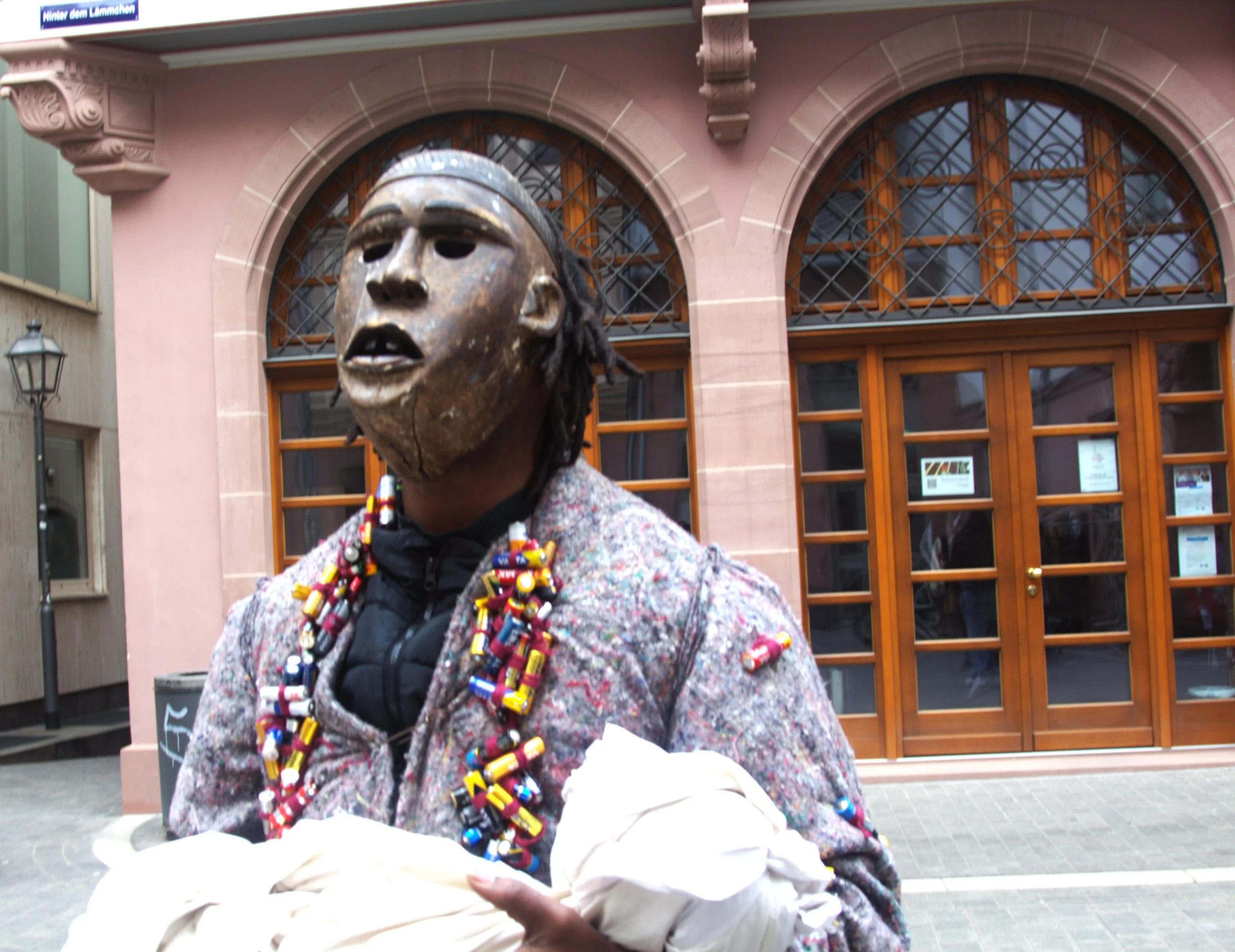
king of the jews 2026, Dom Romer Quartier - frankfurt am main. Photo courtesy Yohsuke Ishizuka.
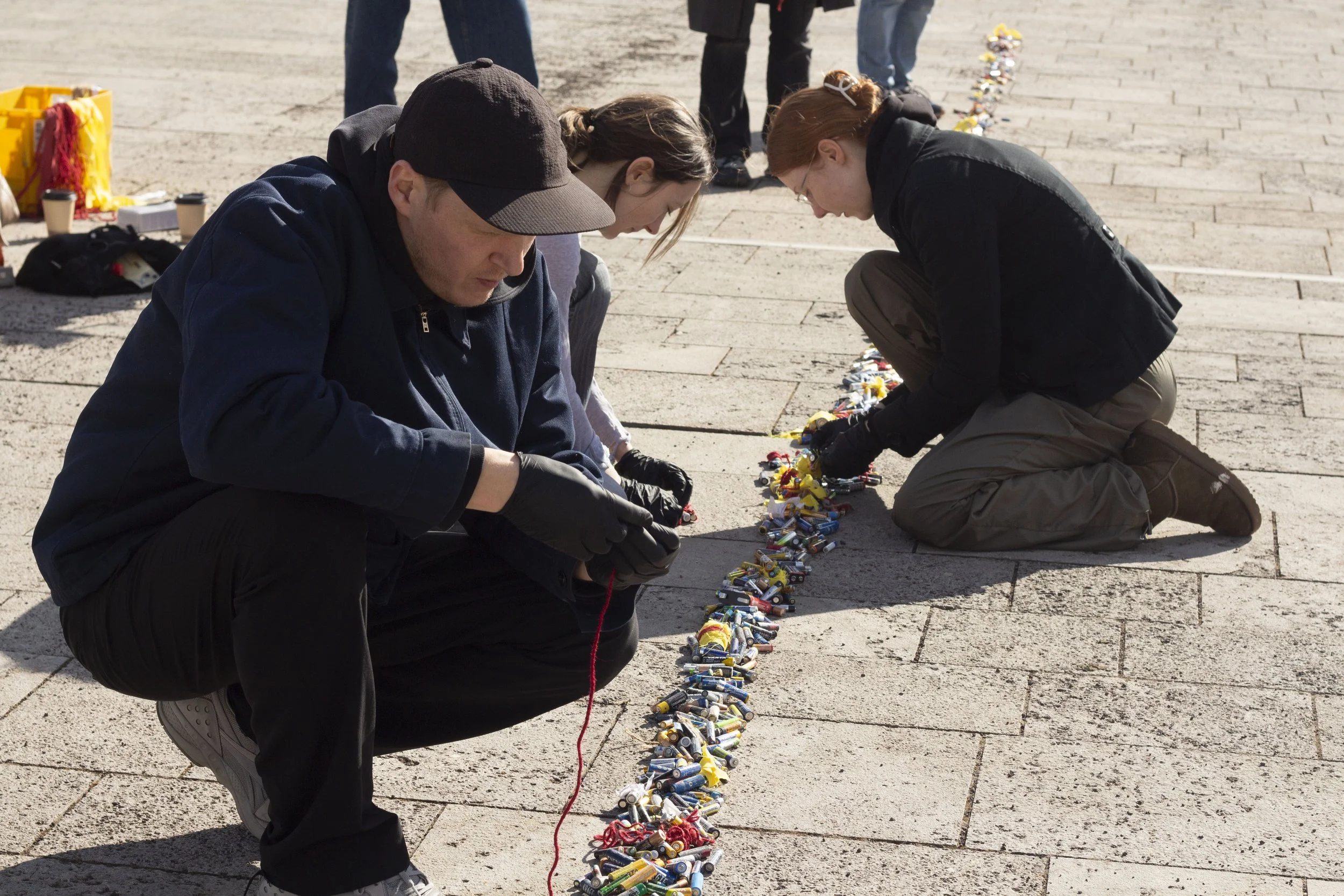
Charge 2026, Johanne Goethe Universitat Westend Campus, Photo courtesy Yohsuke Ishizuka.
Beyond the banks of the Main, Larry and his partner in both artistic practice and life, Sopo Kashakashvili, continue to expand these investigations through their collective, La Caoba. At the beginning of the year, they presented Chain of Cycle in Munich in collaboration with curator Sophie Eisenried and Habibi Kiosk. Carrying a pile of worn and discarded clothing through Maximilianstraße, one of Germany's most prestigious destinations for luxury consumption, the performance introduced a contrasting economy into a space defined by aspiration, exclusivity, and display.
The action unfolded quietly yet persistently. Moving through a landscape of luxury storefronts with traces of previous lives draped across their bodies, the artists transformed used garments into carriers of memory, labour, and circulation. In doing so, they exposed the hidden trajectories that underlie systems of consumption.
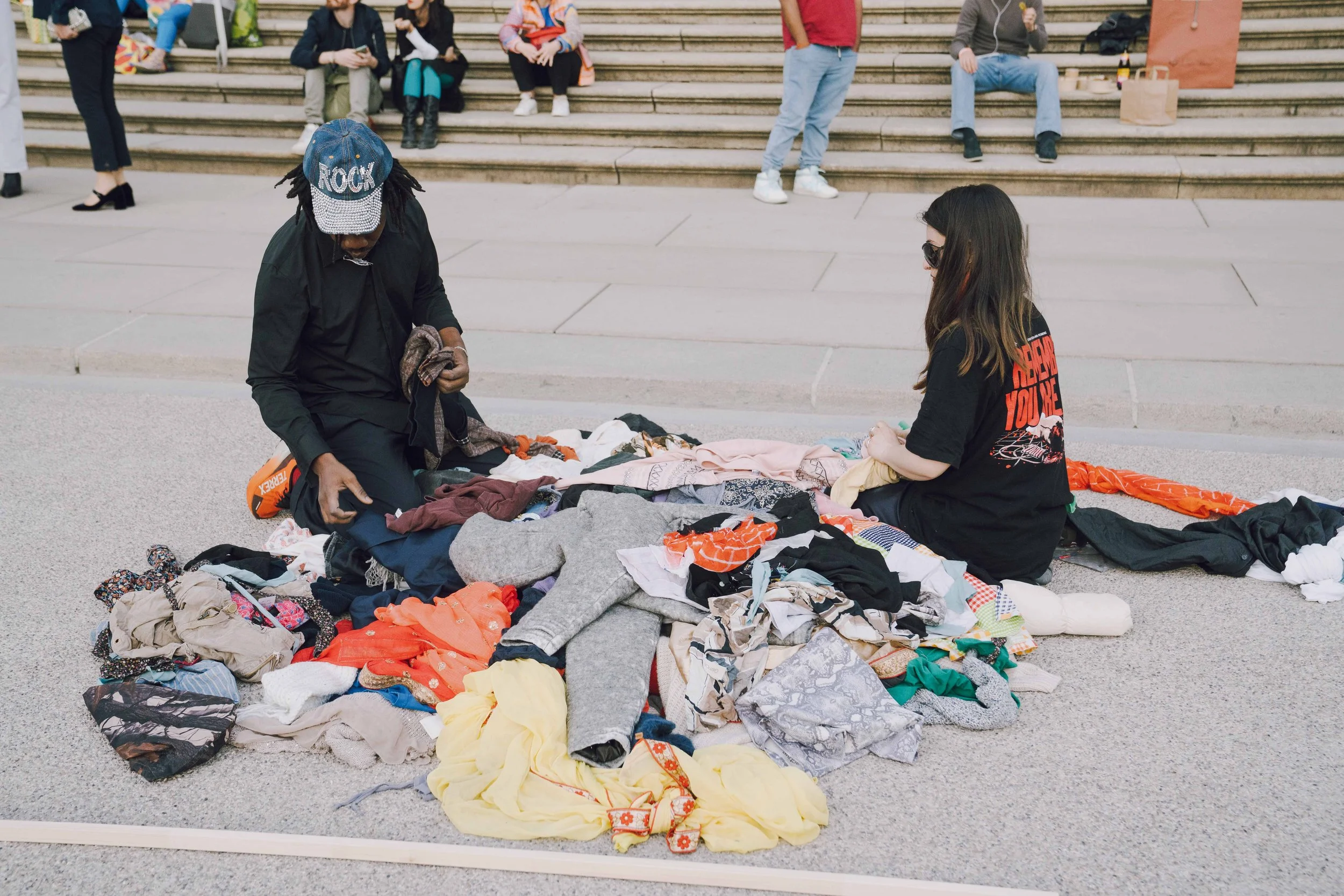
Chain of cycle 2026 Habibi Kiosk Muechener Kammerspieler- Munich, Photo courtesy Priscillia Grubo
This spring feels unusually warm and restless, as though sunlight has once again heated the surface of the earth, reactivating not only life itself but also the pulse of those inclined to take action. The texture of urban space is composed of countless layers of history and memories. It is saturated with trauma and joy, victories and failures, exhaustion and desire, as well as the innumerable repetitions of everyday life that often pass unnoticed. Beyond offering a degree of liberation from institutional frameworks, public performances and interventions possess an immediacy that indoor exhibitions can rarely provide. Rather than functioning as a neutral backdrop, the city becomes an active participant in the work. Passersby, weather, infrastructure, regulations, and chance encounters continually reshape the conditions through which meaning emerges. The unpredictable responses of those who encounter the work become inseparable from the work itself.
Between the artist and the surrounding environment, something arises that neither side can fully control. Each responds to the other in the present moment, without excessive preparation or calculation. In this sense, mistakes, interruptions, and unforeseen encounters are not obstacles to the work but essential components of it. What emerges is not simply an artistic gesture situated within the city, but a temporary condition produced through the encounter between bodies, histories, spaces, and circumstances.
Within these encounters, layers of the urban fabric, interwoven with private memories and collective histories, come into view. They become conditions through which expression can take place. Perhaps it is not a question of which position any element occupies, nor whether something is sufficiently accurate, complete, or prepared before it is allowed to appear. Presences encounter one another before they are fully explained, interpreted, or fixed into position. Existing side by side, sometimes overlapping, emplifyingng and sometimes diverging, they alter something unintentionally or preserve something deliberately. Through their presence, they participate in shaping the spaces they inhabit. The city, in turn, is continuously formed through these encounters, accumulations, and traces of being.
